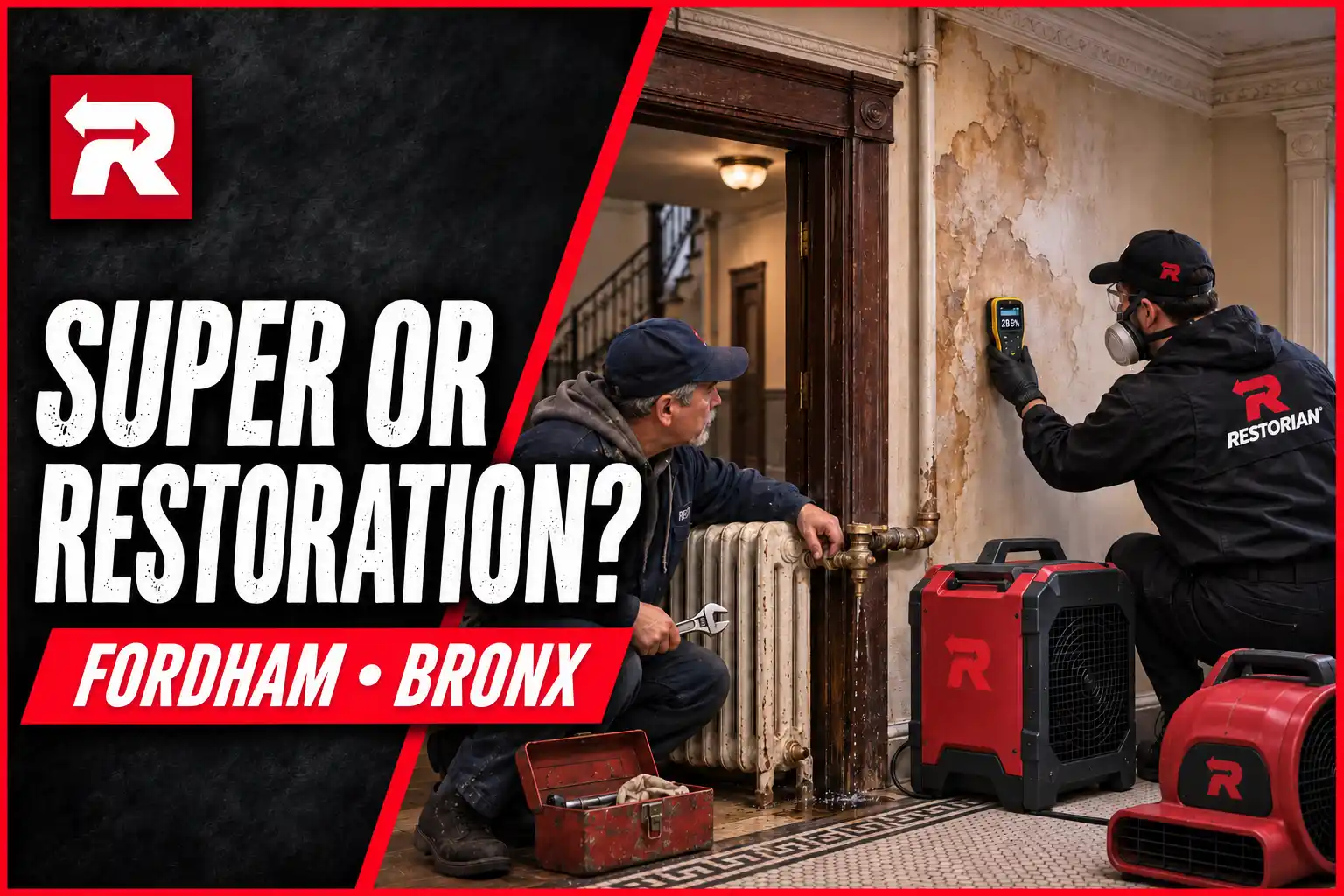
There is a moment in almost every prewar water loss when somebody says the word “demo,” and this post exists to slow that moment down. Around Fordham, the buildings that line the Grand Concourse corridor and the side streets off Fordham Road carry original plaster, oak parquet, and mouldings that no contractor can buy today at any reasonable price. Water damage restoration, done properly and started fast, saves most of it most of the time. Started slow, or skipped in favor of the sledgehammer, the same loss takes the irreplaceable parts of the apartment with it. The difference is rarely the water. It is the clock, and the crew’s attitude toward the materials.
What the Prewar Materials Actually Tolerate
The building trades of the 1920s built wetter than we remember. Plaster was applied wet by the ton, oak was laid over sleepers that breathed, and the assemblies were designed to take seasonal humidity swings that would warp a modern townhouse. That history is why the materials forgive more than people expect, within limits worth knowing.
Plaster over wood lath or metal lath. Plaster is mineral; it does not feed mold the way drywall’s paper facing does, and it holds its structure through a soaking that would turn gypsum board to pudding. Dried promptly under monitoring, with air movement on both faces where cavities allow, plaster walls routinely survive losses that would condemn drywall outright. The limits: saturated ceiling plaster is dangerous, because the keys that grip the lath soften and let go in heavy sheets, and plaster that stays wet against its lath for days grows problems inside the assembly that no surface treatment reaches. The window is real, but it is measured in days, not hours, if drying starts immediately.
Parquet and strip oak. The borough’s floors cup first and ask questions later: boards absorb from below, edges rise, and the floor looks ruined within a day. Looks is the operative word. Oak that gets specialty drying mats and controlled dehumidification within the first day or two frequently flattens back as its moisture equalizes, to the open astonishment of owners who had already priced replacement. The same floor after a week of hope, or after someone “dried” it with heat alone and case-hardened the boards, is a demolition line item.
The mouldings and doors. Solid wood trim and panel doors take water slowly and release it slowly. They almost never need to come out because of the water itself; they come out when demolition around them is careless. Flagging them for protection on day one costs nothing, and on the losses where some demolition is unavoidable, careful crews pull and number the trim for reinstallation the way the better renovation trades do. The profile on a 1927 door casing is not at the lumberyard.
Water Damage Restoration in Fordham: How We Run These Buildings
Our crews come over the George Washington Bridge and down the Cross Bronx at any hour, and the Fordham playbook is tuned to the housing stock: moisture mapping first, across every unit in the wet stack, because prewar cavities and chases carry water past where the eye stops. Containment and drying equipment sized for plaster assemblies, which dry more slowly than drywall and reward patience with survival. Daily metering logged unit by unit, both to steer the drying and to build the multi-policy insurance file these buildings always need. And a standing bias, stated openly: we would rather dry an original wall than replace it, and we say so to adjusters in the language of readings and dry standards, which is the language that wins that argument. How we serve the borough is on our Bronx service page, and the full service scope is under water damage restoration. When the ceiling is sagging on Valentine Avenue: Restorian, (888) 788-5038, around the clock.
The First Hours in a Fordham Stack, Floor by Floor
A vertical loss rewards order. Stop the source, which in a prewar means the basement riser valves and the super’s knowledge of them. Then protect the people: saturated ceiling plaster over a bed or a crib is the first thing we check in every wet apartment, because a let-go is heavy and sudden, and poking a visible belly with a broomstick is exactly the wrong move. A controlled relief hole at the low point, bucket underneath, is the right one. Then the triage walk, top of the stack downward, photographing everything before furniture moves, because six households’ claims will be built from the first hour’s record.
What tenants can do before any crew arrives is small and decisive: photograph, move what matters off the floor, open interior doors so air can move, and resist the urge to crank the radiators, because heat without dehumidification pushes moisture deeper into the assemblies and case-hardens the floors everyone is trying to save.
One more word for the household on the top of the stack, where the loss started: do not clean up before the photos exist, and do not let embarrassment rush the record. The origin unit’s documentation matters most of all, because the category of the water and the timeline of the response are established there, and every policy in the building will read from that page. A washing machine hose is a covered accident; the story told badly can sound like neglect. Tell it with photographs and timestamps, and the claims downstairs settle faster too.
The Radiator Wrinkle
Winter adds a loss category the suburbs barely know: steam and hot-water heating failures, and they are hard on finishes in their own particular way. The water arrives hot, which drives it into plaster and finishes faster than a cold supply leak, and it arrives carrying decades of system minerals, which is why a radiator loss stains brown and stubborn where a supply leak stains pale. The restoration response shifts accordingly: faster containment of the spread, because hot water travels further before it cools and slows; cleaning chemistry on the stained plaster before anyone repaints, because paint over mineral staining is a stain with a subscription; and attention to the floor finish under and around the radiator, where hot water lifts polyurethane in a signature halo. None of this changes the fundamentals, map it, dry it, log it, but a crew that has worked a borough of steam-heated buildings reads these losses faster, and reading them fast is most of the cost control. If the radiator season also has the system itself misbehaving, that is a plumber’s call first and ours second; the division of labor is clean, and the drying should never wait on the mechanical repair to finish.
When Demolition Is Actually Right
Honesty requires the other list, because romance about old buildings should not keep anyone living with a hazard. Plaster that took Category 3 water, sewage or rising storm water, comes out, whatever its age; contamination inside a lath assembly cannot be cleaned by anyone’s promise. Ceiling sections whose keys have sheared come down on our schedule rather than their own. Insulation in furred-out renovation walls is a sponge and gets replaced, which often means the renovated sections of a prewar apartment are demolished while the original fabric around them survives, an irony our crews see weekly. The point was never that nothing comes out. It is that the decision should be made by meters and category, not by the convenience of the crew holding the hammer.
The Claim, Multiplied by Six
Everything about prewar claims is the standard playbook multiplied by the stack. The building’s master policy leads on structure and common elements; each tenant’s or owner’s policy covers contents and improvements; and the questions that decide payouts are the ones answered in the first days: what category of water, which units, what readings, what timeline. Drying logs that show plaster brought to dry standard inside the window are also what later defends the building against the mold complaint that never happened. We build the file that way on every loss, floor by floor, because we have watched thin documentation turn one wet riser into years of neighbor-versus-neighbor friction. For the maintenance-versus-restoration decision that comes before any of this, our guide from last week walks the line: Restoration Company in Fordham, Bronx: Where Maintenance Ends and Restoration Begins.
Frequently Asked Questions
How fast can Restorian reach Fordham, and does the hour matter? Minutes from the George Washington Bridge via the Cross Bronx, at any hour, and yes, the hour matters twice here: saturated materials begin supporting mold within 24 to 48 hours, and prewar plaster and parquet are savable early and demolition late. Night calls get trucks, not voicemail.
Our management company says wet plaster always has to come out. True? No. Uncontaminated plaster dried promptly under monitoring routinely survives, and it is worth saving: it is better material than its replacement would be. What is true is that plaster soaked by contaminated water, or left wet for days, does have to come out. The meters and the water category make that call, not a blanket rule.
The parquet is cupping. Is it already lost? Usually not. Cupping is oak doing what oak does when its underside is wetter than its top, and boards that get drying mats and dehumidification within the first day or two frequently flatten back. Do not add heat without dehumidification, and do not wait for the cupping to “settle” on its own. The floor is announcing a deadline, not a verdict.
How long does drying a prewar apartment actually take? Longer than drywall, and that is normal: plaster assemblies typically run three to five days of monitored drying where modern construction runs two to three, because the material is denser and holds moisture deeper. The daily readings are the schedule; the job ends when the numbers hit dry standard, not when a calendar says so. Rushing it, or declaring victory by touch, is how a saved wall becomes a spring mold call.
Who should call you: the tenant, the super, or management? Whoever reaches us first; we have taken these calls from all three and from the board president’s cell. The response is the same: stop the source with the super, map the stack, and get drying running while the paperwork sorts itself into the right policies.
The buildings around Fordham have carried a century of water already, and the point of water damage restoration in Fordham, Bronx is to make sure this loss is a chapter, not the ending. Fast drying saves the plaster; the plaster is the building. Restorian, (888) 788-5038, 24 hours a day, bridge traffic permitting and usually faster than that.
Related reading: Water Damage Restoration in Englewood, NJ: Why Fans and Hope Are Not a Dry-Out