Every week in Englewood, somebody wins a fight against standing water and then loses the war to the moisture they could not see. The pattern deserves its own case file in the water damage restoration business: the homeowner who shop-vacs the basement dry by midnight, aims three box fans at the floor, declares victory by Sunday, and calls us in March about a smell. This post is about the difference between water that looks gone and water that is gone, because that difference is where most of the money in a water loss actually lives.
The Weekend That Costs More Than the Water
Here is the uncomfortable physics. When water enters a building, the puddle is only the visible fraction. Drywall wicks it upward, well past the stain line, at a rate that has nothing to do with how fast you mop. Subfloors drink through seams. Sill plates, baseboards, and the bottom of the wall cavity hold water in places no fan’s airflow ever reaches. A surface can read bone dry to your palm while the material two inches behind it sits at saturation.
Household fans move air across surfaces. They do almost nothing to the water inside materials, and they do nothing at all to the humidity that evaporation dumps into the room, which promptly re-condenses into whatever cool surface it finds. This is why the fan-and-wait weekend so often produces a house that smells fine on Sunday and grows a problem by spring: saturated materials begin supporting mold growth within 24 to 48 hours, and a wall cavity at 90 percent moisture is a petri dish with paint on it.
The blunt arithmetic from our side of the trade: losses dried professionally inside the first day are routinely repairs measured in days. The same losses after a hopeful weekend are reconstruction measured in weeks, and sometimes a mold remediation on top. Same house, same water, different calendar.
Water Damage Restoration in Englewood: The Local Variables
Englewood makes this trade interesting, because the city is really three different drying problems wearing one zip code. The East Hill’s older colonials and tudors are plaster, original hardwood, and full-height basements: materials that reward speed enormously (plaster dried promptly under monitoring often survives what would condemn drywall) and punish delay just as hard. The downtown blocks around Palisade Avenue add mixed-use buildings, where one burst line upstairs becomes three businesses’ problem downstairs and the drying plan has to respect all of them at once. And the lower-lying streets toward Overpeck Creek contribute the storm calls, where the water arrives with the weather and the basement is the first room to know about it.
Our crews are based minutes away in Englewood Cliffs, which matters because everything in this post is a clock. We cover every Englewood neighborhood 24/7, we arrive with the meters and the drying equipment on the truck rather than “coming back Monday with the gear,” and we have dried every one of those three building types more times than we can count. How we work in the city, response times included, is on our Englewood service page, and the wider coverage map lives on our Bergen County page. When the water is on the floor and the clock is running: Restorian, (888) 788-5038, answered around the clock.
The First Hour: What to Do Before the Truck Arrives in Englewood
The call is placed and the crew is rolling; the next 45 minutes still belong to you, and they are worth real money. In order:
Stop the source if you safely can. For plumbing failures, that is the fixture’s supply valve or the main, which in most of this city’s housing stock sits on the front foundation wall near the meter. Every minute of flow you prevent is extraction nobody has to do.
Kill the electricity to wet rooms. At the breaker panel, not at the outlet. Water finds outlets, floor lamps, and extension cords long before it looks dangerous, and a flooded room with live power is not a cleanup scene yet.
Photograph before you touch. Wide shots of every affected room, close shots of the waterline, the source, and anything valuable, all before a single towel moves. The claim will be built from this record, and no adjuster has ever complained about too many photos.
Lift what gravity will ruin. Furniture legs onto foil or blocks, rugs off wet floors, electronics and documents up and out. Skip the heroics with soaked carpet; it weighs triple and the pad underneath is already a loss.
Do not run your household vacuum on standing water. It seems obvious until the adrenaline is up. It is not rated for it, and the shock risk is real.
That is the whole list. Everything after it is equipment work.
What Water Damage Restoration Actually Involves
Professional water damage restoration is not stronger fans. It is a different process with a different goal: verified dryness inside the materials, documented well enough to satisfy an insurance adjuster. The full scope of our water damage services covers everything from single-room losses to whole-building floods, but the spine of every job is the same, stage by stage:
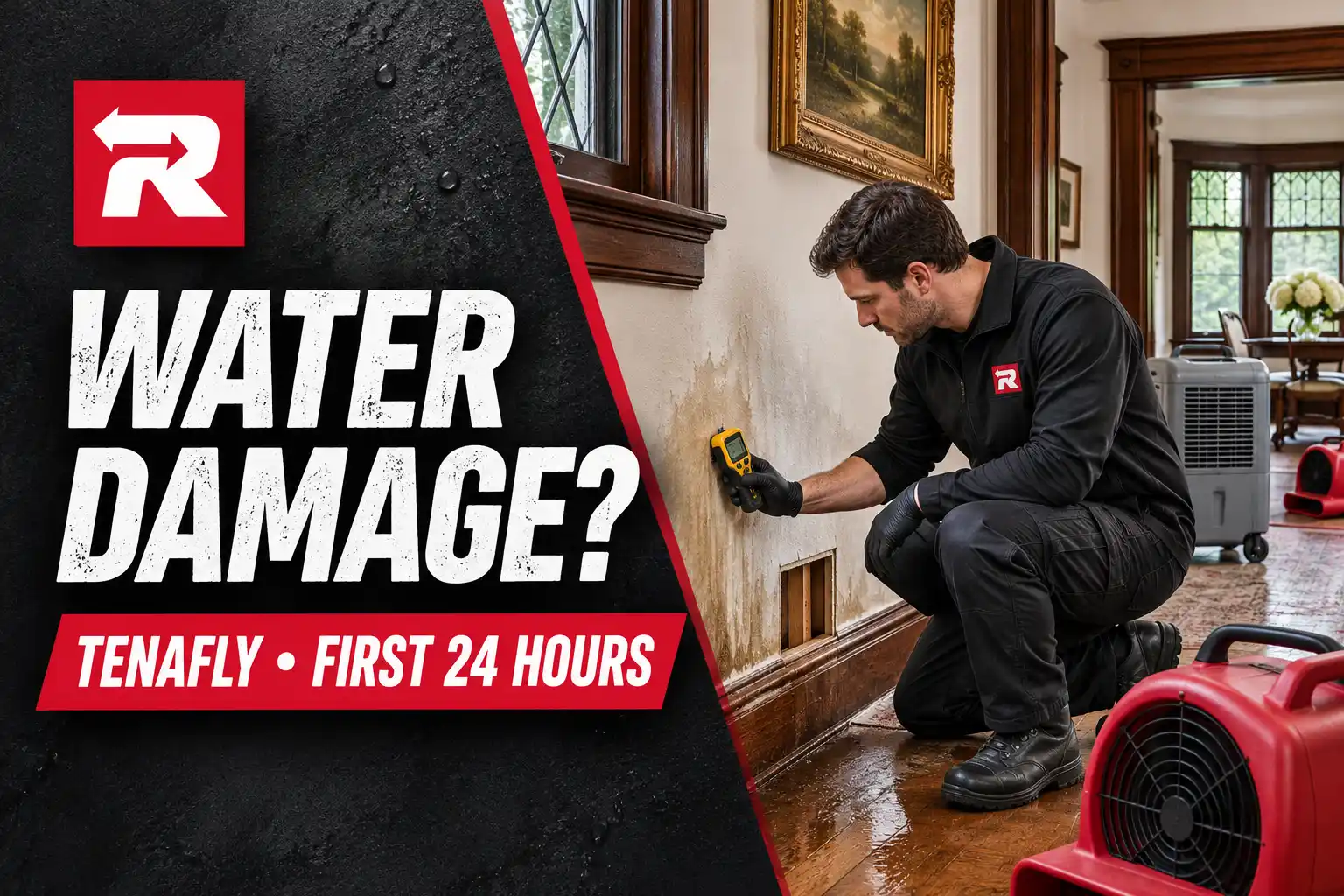
Mapping before machinery. The first hour is spent with moisture meters and thermal imaging, tracing where the water actually went rather than where it shows. The map decides everything that follows, which walls get drying, which get opened, which get left alone. Skipping the map is how wet cavities get sealed behind “finished” rooms.
Extraction beats evaporation. Every gallon physically removed is a gallon that never has to be dried. Truck-mounted extraction pulls water out of carpet, pad, and seams at a rate no wet-vac approaches, and it is the single highest-leverage hour of the whole job.
Containment and controlled drying. Air movers are placed to drive airflow across wet materials at calculated angles, and commercial dehumidifiers pull the evaporated moisture out of the air before it can migrate. The two work as a system; the dehumidifier is the half the fan-and-wait weekend is missing. Where needed, rooms are sealed into drying chambers so the equipment works on the wet area instead of the whole house.
Daily monitoring to a dry standard. Readings are taken every day, in the same mapped spots, until the materials hit their documented dry standard, not until they feel dry. This is also the record that makes the insurance file hold together.
Then, and only then, rebuild. Closing walls over verified-dry framing is renovation. Closing them over damp framing is scheduling a future demolition.
Not All Water Is the Same Water
One more variable decides half the plan before a single fan is placed: the category of the water. The industry sorts it into three. Category 1 is clean supply water, a burst pipe or a failed icemaker line, and it is the most forgiving: most materials it touches can be dried and saved if the response is fast. Category 2, so-called gray water, has been somewhere on its way to you: washing machine discharge, dishwasher overflow, an upstairs tub through a ceiling. It carries enough contamination that porous materials get far less benefit of the doubt. Category 3 is the unforgiving one: sewage backups and rising storm water, which in the lower-lying blocks of any river-adjacent county arrives carrying whatever the street was holding. Category 3 losses are as much a sanitation job as a drying job, and the savable list shrinks accordingly. Two practical consequences: first, water degrades over time, so a Category 1 loss left sitting can be treated as Category 2 by the time it is addressed, which is one more cost of the hopeful weekend. Second, the category belongs in the documentation from hour one, because it drives both the protocol and the claim.
The Mold Clock and the Insurance File
Two deadlines run underneath everything above. The biological one: 24 to 48 hours from saturation to the conditions mold needs, which is why “we’ll see how it looks next week” is the most expensive sentence in this trade. And the paperwork one: insurance claims are built from documentation, and the difference between a smooth claim and a contested one is usually photographs taken before cleanup, a moisture map from day one, and drying logs that show the loss was handled promptly. A homeowner who dries “well enough” with fans and files a mold claim in March is often filing against a policy that excludes mold from neglected water. The early paperwork is worth real money; we build it into the job because adjusters respect data more than adjectives.
What Survives and What Does Not
The honest list, which clients deserve before anyone starts swinging a hammer. Usually savable with fast professional drying: hardwood floors (specialty drying mats within day one frequently flatten cupped boards back), plaster walls, framing, tile over concrete, and most solid-wood furniture. Usually not savable, and better replaced than gambled on: soaked carpet pad, saturated particle-board furniture, mattresses, and any drywall that held Category 2 or 3 water (washing machine discharge, sewage-tinged storm water). The in-between pile is where judgment earns its keep: books and documents can often be freeze-dried if they reach a specialist quickly; electronics that merely sat in humidity frequently survive while anything submerged should be written off and photographed for the claim; and upholstered furniture rides entirely on the water’s category, savable from a clean supply leak, a loss from anything gray or worse. A good restoration company tells you which pile each item is in on day one, with the moisture readings to back it up. We do not have an Englewood case study written up yet to link here (when one exists, this is where it will go), but the pattern above is drawn from years of them.
Frequently Asked Questions
How fast can Restorian reach an Englewood home? We are based in Englewood Cliffs, minutes away, and we run 24/7. For active-water emergencies anywhere in the city, from the East Hill to the blocks near Overpeck Creek, same-hour response is the norm, and the extraction equipment arrives on the first truck.
Can I just run fans and dehumidify with a household unit? For a cup of spilled water, yes. For any loss that wet the walls, flooring seams, or a ceiling, household equipment lacks both the extraction power and the monitoring to verify materials are dry inside. What feels dry on Sunday is often still wet at the core, and that is exactly the water that becomes a mold problem.
Does homeowners insurance cover water damage restoration? Sudden and accidental losses (burst pipes, appliance failures) are generally covered; gradual leaks and neglected water often are not, and mold from delayed drying is frequently excluded. Document everything before cleanup and start drying immediately; both protect the claim. We bill most carriers directly.
What does the process cost? It depends on category of water, square footage affected, and how early drying starts, which is why the same loss can vary so widely between a Tuesday call and a Monday-after call. Assessment is free, the moisture map is shown to you, and pricing is explained before any work begins.
If the water is on the floor right now, the clock is already running. For water damage restoration in Englewood, NJ, call Restorian at (888) 788-5038, 24 hours a day. The water that looks gone is not the water that matters; we bring the meters that find the rest.
Related reading: The Leak That Ran All Day: Water Damage Restoration in Tenafly, NJ