The hardest thing to explain to an Englewood family standing on their lawn at 3 AM is that the event is not over when the trucks leave. Fire damage restoration exists as a specialty precisely because of what happens next: the fire stops, and the damage keeps moving. Soot is not dirt sitting on surfaces; it is an acidic chemical residue that goes on working for days, etching glass, pitting metal, and yellowing finishes while everyone understandably assumes the worst has passed. This post is about that second, slower fire, and why the week after the flames decides so much of what the loss eventually costs.
Every House Fire Is Three Events, Not One
The flames are the first event, and usually the most contained. The second is smoke, which travels the whole house even when the fire touched one room, riding heat currents through open doors, HVAC ducts, and the gaps around fixtures, then condensing on every cool surface it finds. Closets on the far side of the house from the fire routinely hold soot, because smoke is pressure-driven and patient.
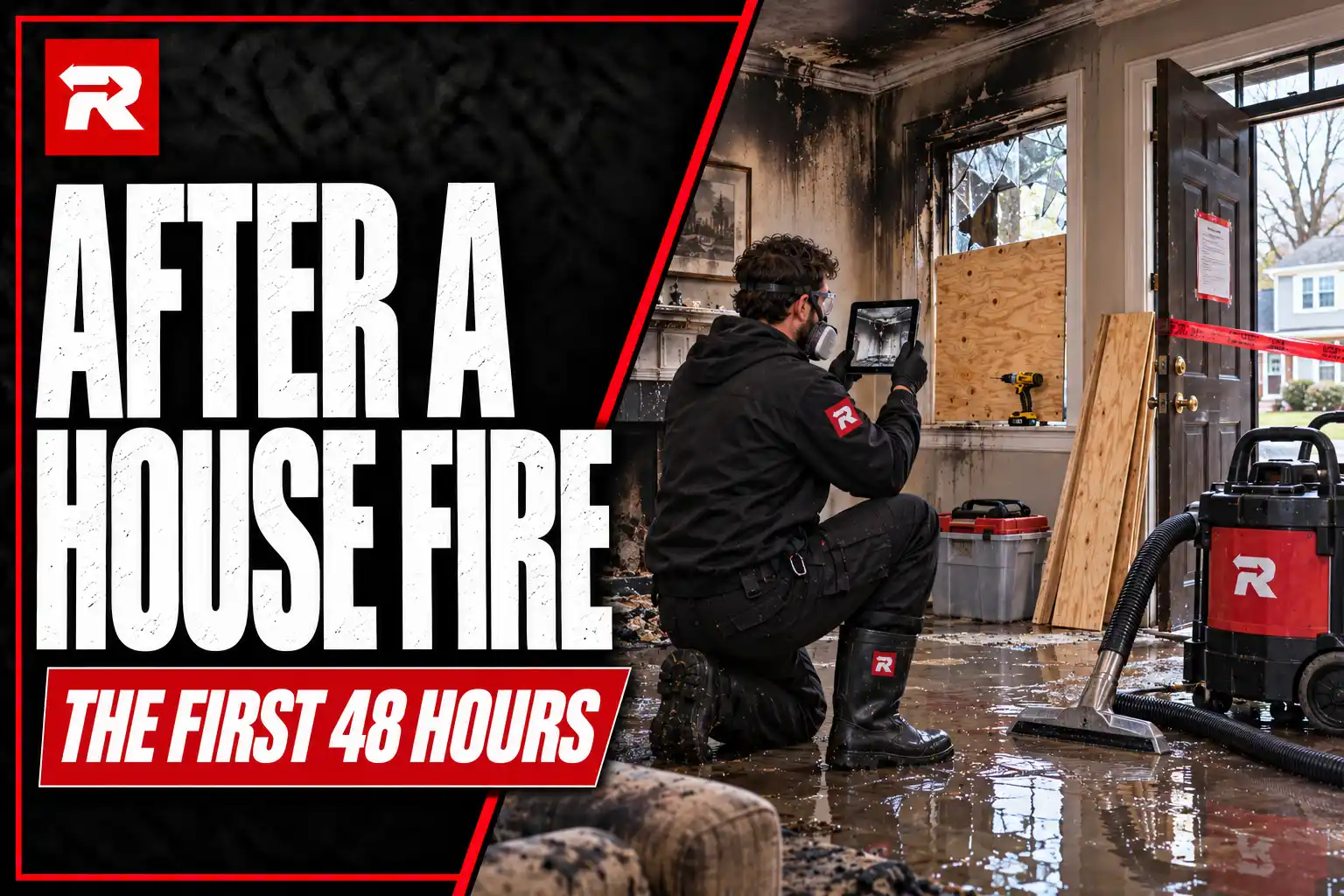
The third event is water. Suppression is not gentle: what the fire did not touch, the hoses often did, and a fire loss is nearly always a water loss wearing a burned jacket. The drying has to run on the same clock as any flood, 24 to 48 hours before saturated materials start supporting mold, which means a proper fire response runs two restorations at once from day one.
The First Hours: What a Family Can Do Safely
Before any professional work begins, there is a short list worth knowing, because the instinct to start scrubbing is strong and mostly wrong.
Do not re-enter until the fire department clears the structure, and treat their word as final; hidden hot spots and compromised framing are both real. Once inside, resist the rag. Wiping soot, especially with anything damp, smears and sets residue that a dry-cleaning sponge would have lifted. Do not run the HVAC system, which would pull soot through the ducts and redistribute it into every untouched room, and do not plug in or power on electronics that were in the smoke field; soot inside a device plus current is how salvageable electronics finish the job the fire started. If the weather allows and the department permits, ventilation helps, but it is a comfort measure, not a cleanup.
What does help: photographs of everything exactly as it stands, a call to the insurer to open the claim, and securing the structure. Then let the cleaning start with the chemistry matched to the residue, which is the next section’s subject.
Soot Is Not Dirt, It Is Chemistry
This is the part the hardware-store approach misses. Soot is the acidic residue of incomplete combustion, and what it does depends on what burned and what it landed on. Dry soot, from fast, hot fires of paper and wood, sits loose and powdery and smears catastrophically when wiped with a wet rag, which is why well-meaning cleanup so often sets the stain. Wet soot, from slow, smoldering fires of plastics and synthetics, is greasy, pungent, and bonds to surfaces. Protein residue, from kitchen fires, is nearly invisible but discolors finishes and holds odor with remarkable commitment.
Then there is the clock. Within hours, acidic soot begins discoloring plastics and marble. Within days, it etches glass, corrodes metal fixtures and electronics, and yellows countertops and grout permanently. A chandelier, a stovetop, a television that could have been cleaned and saved on Tuesday is often a write-off by the following Monday, not because anyone was careless but because nobody told the family the residue was still working. Fast, surface-correct cleaning is not cosmetic; it is the difference between cleaning and replacing a house’s contents.
Fire Damage Restoration in Englewood: The Local Picture
Englewood’s building stock shapes these losses in specific ways. The East Hill’s older colonials carry plaster walls, which actually resist smoke penetration better than drywall, and original hardwood and millwork that reward careful cleaning over demolition, but their balloon-framed walls can channel smoke between floors in ways newer construction does not. Downtown’s mixed-use blocks add the multi-tenant problem: a kitchen fire in one unit sends protein smoke through shared cavities, and the restoration has to be mapped across every affected space, not just the burned one. And everywhere in the city, winter fires (heating season is fire season) mean suppression water meets freezing temperatures, which adds urgency to the drying side of the job.
Our crews stage minutes away in Englewood Cliffs and work fire losses across the city around the clock, from assessment and board-up through the last day of odor work. How we cover the city, response times included, is on our Englewood service page, and the wider map is on the Bergen County page. When the trucks are leaving and the questions are starting: Restorian, (888) 788-5038, any hour.
What Professional Fire Damage Restoration Involves
The full scope of our fire and smoke services runs from the first-night board-up to the final odor clearance, and the spine of every job looks like this:
Securing and assessing. Board-up and roof tarping first, because an open structure invites weather and worse. Then the assessment walk: what burned, where the smoke traveled (further than it looks), what the water touched, and the soot type on every class of surface, because the soot type dictates the cleaning method.
Drying, immediately. The suppression water gets the full water-loss treatment, extraction, air movement, dehumidification, and daily metering, on its own 24-to-48-hour clock. Skipping this step trades a fire problem for a mold problem.
Soot removal, surface by surface. Dry soot comes off with dry-cleaning sponges before any wet method touches it. Wet soot needs degreasing agents. Protein residue needs enzymatic cleaners and patience. Marble, brass, glass, and electronics get priority because of the corrosion clock. The order and chemistry matter more than effort; this is where the trade earns its keep.
Odor, in layers. Smoke odor is not one problem: it is residue in materials, and it is odor molecules lodged in cavities and soft goods. The sequence runs source removal (burned material out), deep cleaning, sealing where residue penetrated beyond cleaning, and then air treatment, thermal fogging, hydroxyl, or ozone, chosen by what the space and its contents tolerate. Any step done out of order gets repeated.
Contents. Pack-out, itemized inventory, cleaning by category (hard goods, textiles, electronics, documents), and climate-controlled storage while the structure is worked. Textiles respond well to specialized ozone and wash processes that ordinary dry cleaning cannot match, and documents and photographs can often be stabilized if they reach the right hands early. The inventory doubles as the claim’s contents schedule, which is one more reason it gets built carefully rather than quickly.
The ductwork, always. Smoke rode the HVAC system during the fire, and the system will faithfully replay it every time the blower runs until the ducts are cleaned and the filters replaced. Duct cleaning is the step most often skipped by non-specialists, and it is the most common reason a “finished” fire job still smells like one.
Why “Air It Out and Repaint” Fails
Every restoration crew has walked into a house where the previous answer was open windows, a weekend of fans, and a fresh coat of paint. The pattern is reliable: the house smells fine in the dry cold of February and smells like the fire again on the first humid day of June, because odor molecules in wall cavities, insulation, and subfloors reactivate with moisture. Paint over un-neutralized soot does not seal it; the acids keep working underneath, and the stain and smell both come back through. The honest sequence costs more on week one and dramatically less by year two.
The Claim Side
Fire claims are among the largest and most scrutinized a homeowner will ever file, and the file is built in the first days: photographs before anything is moved, the soot and smoke map, the contents inventory with condition noted, and the drying logs for the suppression water. Two details repay attention early. First, the cause-and-origin investigation belongs to the professionals and the carrier; a family’s job is simply not to disturb the area of origin before the adjuster and any investigator have seen it. Second, cleaning versus replacement is a negotiation conducted in evidence, and an itemized inventory with photographs of each item’s condition is what turns “they said it couldn’t be saved” into a settled line item rather than a dispute. Keep every receipt from the first night onward, hotel included, because loss-of-use coverage reaches further than most families realize. We document to adjuster standards from the first walk because we have watched thin files turn into long arguments. We do not have a written Englewood fire case study to link yet (when one exists, it will live here), but the file-building pattern is the same on every loss we run.
Frequently Asked Questions
How fast can Restorian respond to a fire in Englewood? Around the clock, any day, with crews based minutes away in Englewood Cliffs. Early hours matter twice in a fire loss: the suppression water is on the mold clock, and the soot is on the corrosion clock. Board-up, assessment, and drying typically start the same day the department clears the scene.
Is smoke smell ever permanent? Almost never, when the sequence is run properly: source removal, cleaning matched to the soot type, sealing where needed, then air treatment. What makes odor seem permanent is skipping steps, most often painting before neutralizing. Done in order, even heavy smoke odor is removable.
Can electronics and glass really be ruined days after the fire? Yes. Acidic soot etches glass and corrodes circuit boards and metal finishes progressively; days matter. Items that get priority cleaning early are routinely saved; the same items left coated for two weeks are often write-offs. It is the strongest argument for starting fire damage restoration immediately rather than after the adjuster’s first visit (documentation can run in parallel).
Does homeowners insurance cover all of this? Fire is the core covered peril of a homeowners policy, and that generally extends to smoke, suppression water, contents cleaning, and loss of use while the house is uninhabitable. The friction is rarely coverage; it is documentation, which is why the inventory, the photos, and the logs from week one carry so much weight.
The fire is the event everyone sees. The week after is the event that sets the bill. For fire damage restoration in Englewood, NJ, with the drying, the chemistry, and the paperwork run in the right order from the first night: Restorian, (888) 788-5038, 24 hours a day.
Related reading: Water Damage Restoration in Englewood, NJ: Why Fans and Hope Are Not a Dry-Out · The First 48 Hours After a House Fire (link the October house-fire post’s live URL)