Fordham runs on its buildings, and its buildings run on their supers. Anyone who has lived along the Grand Concourse corridor or the blocks off Fordham Road knows the arrangement: the prewar six-story, the super who has kept it alive for twenty years, and the quiet understanding that most problems stop at his door. This post is about the problems that should not, because a restoration company exists for exactly the losses that outrun a building’s own hands, and in a neighborhood of eighty-year-old multifamily buildings, knowing where that line sits protects tenants, boards, and management companies alike.
What the Building Can Handle, and What It Cannot
A good super handles the burst radiator valve, the overflowed tub caught in time, the small patch of ceiling under a one-time drip. That is maintenance, and nobody does it better.
Restoration is a different trade with different equipment and different stakes. The line is crossed the moment water gets into what cannot be seen or reached: inside walls shared between apartments, under finished floors, down a pipe chase that connects six units vertically. A mop addresses the floor; it does nothing for the wall cavity, and in a prewar building the cavities are highways. The other crossing points: any loss involving sewage, any fire beyond a single scorched pan, anything that has been wet for more than a day, and any loss where two or more units are involved, because at that point the job is as much documentation and coordination as it is drying.
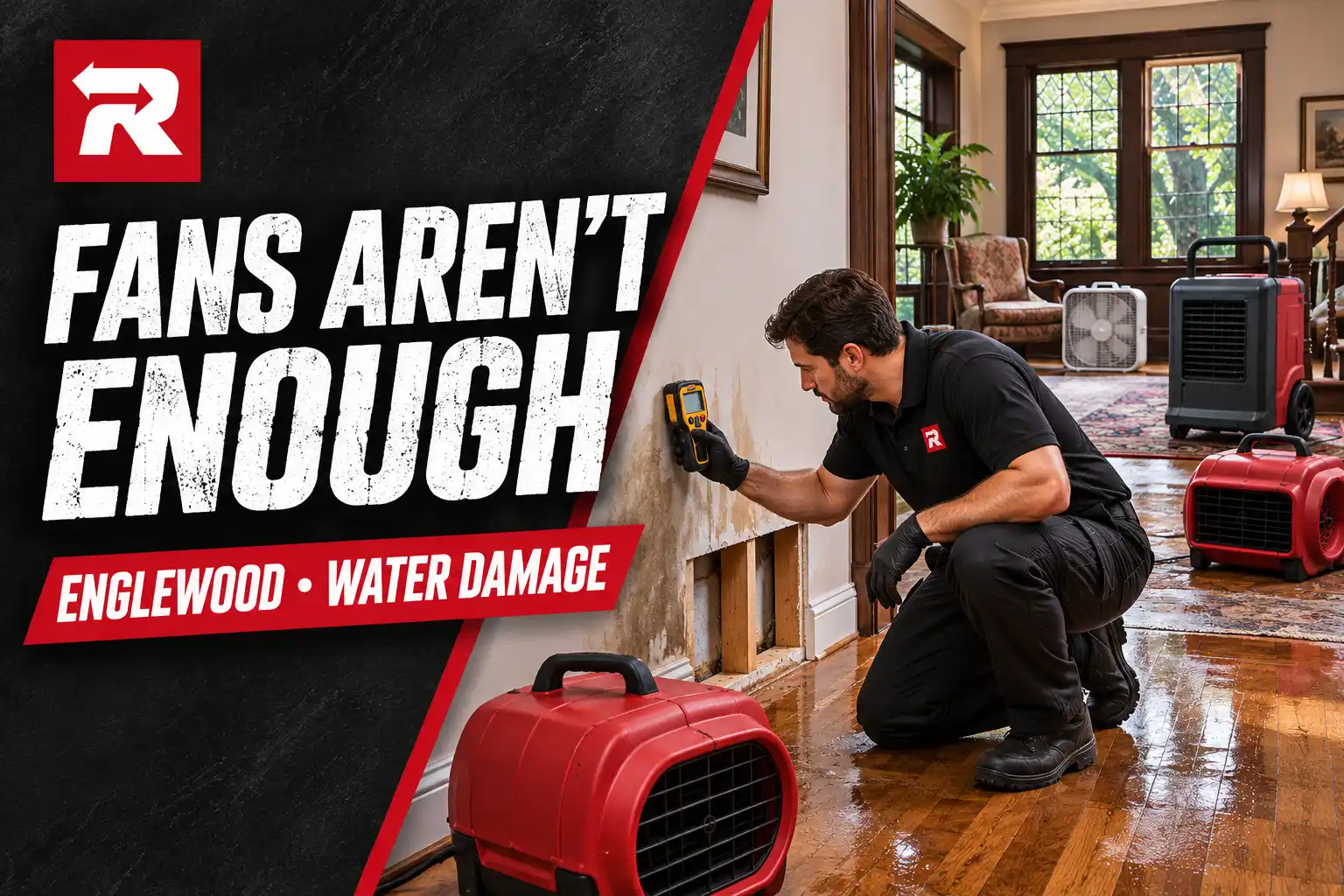
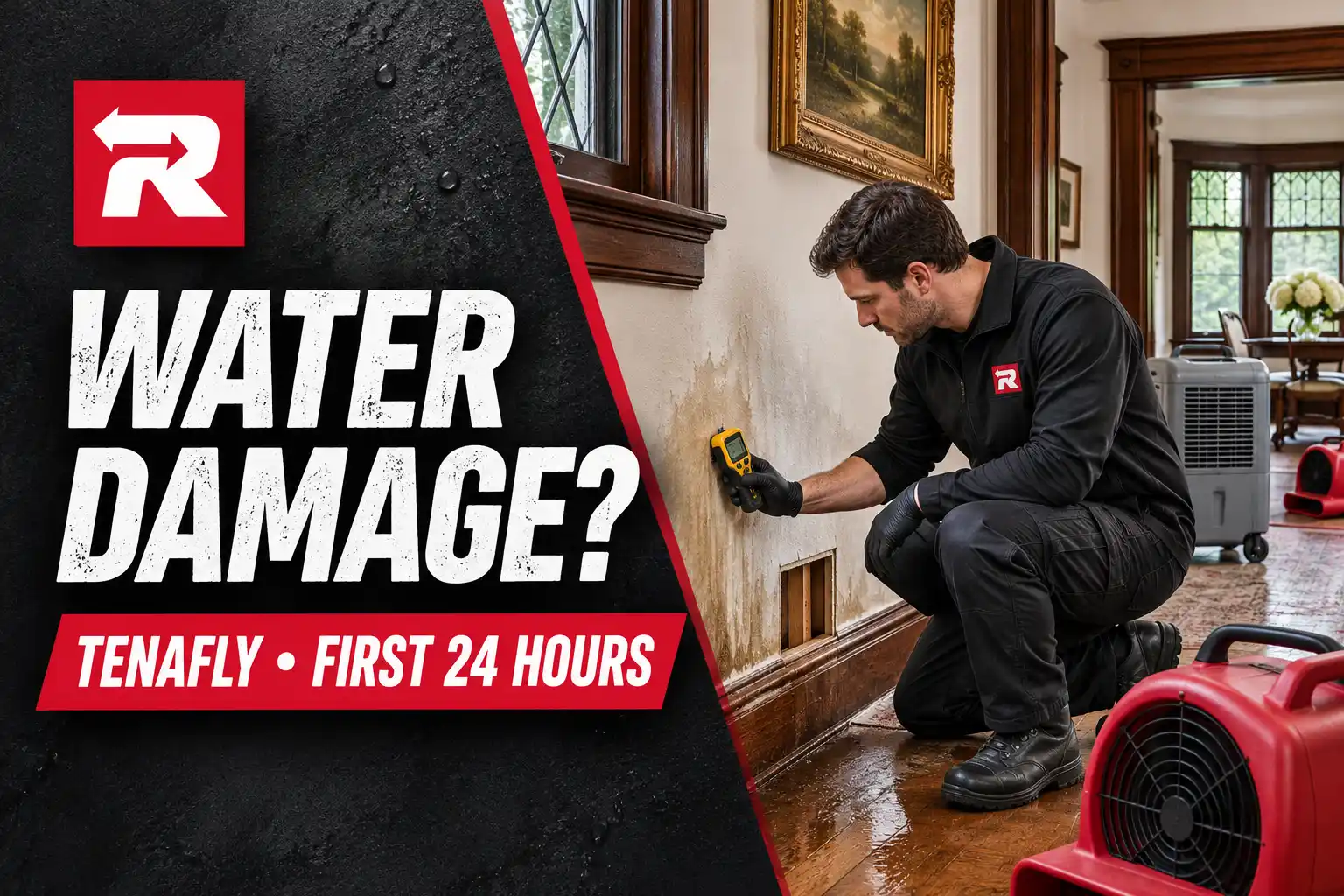
The honest test for a board or manager: if the fix requires only what the building already owns, it is maintenance. If it requires moisture meters, commercial dehumidifiers, containment, or an insurance file that will survive scrutiny, it is restoration, and improvising it in-house is how small losses become structural ones.
There is also a financial version of the same test. Buildings sometimes keep losses in-house to protect the claims history, and sometimes that is even rational for a genuinely small event. But the arithmetic only works if the loss is actually small, and that is precisely what cannot be known without metering. The in-house dry-out that missed a wet cavity does not save the deductible; it defers it, with interest, into a mold remediation and a tenant dispute. Measure first, then decide what stays in-house.
A Restoration Company for Fordham: Why We Are Minutes Away, Not Boroughs Away
Our crews stage in Englewood Cliffs, directly across the George Washington Bridge, which puts Fordham a short run down the Cross Bronx from the trucks. That geography matters because the neighborhood’s losses are time-sensitive in a way its building stock amplifies: water released on a fifth floor is working its way toward the second before the first phone call ends, and saturated plaster and framing begin supporting mold within 24 to 48 hours.
We work Fordham’s buildings the way they demand: unit-by-unit moisture mapping, because a prewar riser leak is never one apartment’s problem; coordination with the super and management rather than around them, because nobody knows the building’s bones better; and documentation built for the multi-policy reality of apartment losses, where the building’s carrier and several tenants’ carriers all want to know exactly what happened where. How we serve the borough is on our Bronx service page. When the ceiling is coming down or the hallway smells like smoke: Restorian, (888) 788-5038, around the clock.
The Prewar Factor: Why Fordham’s Buildings Restore Differently
The buildings that make the neighborhood worth living in also make its losses distinctive, and a restoration company that treats a 1928 six-story like a 2015 condo will damage what it came to save.
Plaster over lath, everywhere. Prewar plaster resists smoke and takes water better than drywall, and it can frequently be dried in place under monitoring where drywall would be demolished. But it fails differently: saturated plaster lets go from ceilings in heavy, dangerous sheets, and the window for saving it is measured in hours, not weeks.
Risers and chases connect everyone. The plumbing runs vertically through stacked apartments, which means one failed line on six can wet five, four, and three before anyone on two hears a drip. Mapping the path with meters, rather than opening every ceiling on the stack, is most of the skill.
Hardwood worth saving. Original oak strip and parquet responds remarkably well to specialty drying mats in the first day. The same floors after a week of hope are a demolition line item.
Steam heat and winter. Radiator season brings its own loss category: failed air valves, split returns, and the scalding, mineral-heavy water they release, which stains fast and travels hot. It is the neighborhood’s signature winter call.
Who Calls Whom: The Multifamily Playbook
Apartment losses fail more often on coordination than on technique, so here is the order that works. The tenant’s job is immediate and small: report it, photograph their own unit before cleanup, and shut what they can safely reach. The super’s job is the building’s systems: stop the source, kill power where water met it, and open the affected line of apartments for assessment. Management or the board brings in the restoration company and opens the building’s claim, and each affected tenant opens their own, because a renter’s policy covers contents and the building’s policy covers structure, and the two files lean on the same day-one documentation.
A worked example, because the order matters more in the abstract than people expect. A riser lets go inside the wall on the fifth floor at 9 PM. The tenant hears it, reports it, photographs the wet wall, and stops. The super kills the riser at the basement valve and walks the stack: five is wet, four is staining, three reports nothing. Management makes the call that night, not Monday, and the crew meters the entire stack including the “dry” third floor, which turns out to be wet inside the cavity, which is the finding that would have become January’s mold complaint. The building’s claim opens that night with photographs and a moisture map attached; the two affected tenants open theirs the next morning with their own photos. Total elapsed time, under twelve hours. Every version of this story that goes wrong goes wrong by adding days between those sentences.
The one mistake we see weekly across every borough: waiting to see how bad it gets. A multifamily loss assessed the same day is one project; the same loss assessed after a weekend is several, and by then the units that “seemed fine” are the contested claims. Our full service scope, from water damage work to fire and smoke losses, is built around that same-day standard.
Fordham Road Is Also a Main Street
The neighborhood’s other loss profile belongs to its commerce. The Fordham Road corridor is one of the busiest retail strips in the Bronx, and its losses have a rhythm of their own: the sprinkler head that lets go over a stockroom at 2 AM, the upstairs neighbor’s overflow discovered when the gate rolls up at 9, the walk-in cooler line that chose a Sunday. Commercial losses add a clock residential ones do not have, because every closed day is revenue, and they add an insurance layer, business interruption coverage, that pays out in proportion to how well the loss and the closure are documented. For store owners along the corridor, the playbook is the residential one with one addition: photograph the stock and the registers area before cleanup, keep the closure dates provable, and get drying running overnight so the gate opens on schedule. We run commercial and residential crews on the same around-the-clock dispatch for exactly this reason.
What to Have Ready Before You Need Anyone
For boards and managers in the neighborhood, five lines of preparation that cost nothing: know where the building’s main shutoffs are and which keys open the basement at 3 AM; keep the super’s walkthrough knowledge written somewhere a covering porter can find; have the building’s policy number and agent reachable outside business hours; keep one restoration company’s number posted where decisions get made, chosen before the emergency rather than during it; and tell tenants once a year, in writing, that “photograph before you clean” is house policy. Every one of those lines shortens the worst night the building will have this decade. And one more, learned from the buildings that handle emergencies best: agree in advance on who has authority to authorize emergency work at night, whether that is the managing agent, the board president, or a dollar threshold written into the management agreement. The 2 AM loss that waits for a quorum is the one that costs the most by sunrise, and every carrier’s policy language expects an owner to take reasonable steps to prevent further damage, not to convene about them.
Frequently Asked Questions
How fast can Restorian actually reach Fordham? Our trucks stage directly across the George Washington Bridge, and the neighborhood is a short run down the Cross Bronx from there, any hour. For active multifamily losses we dispatch immediately, because vertical buildings convert minutes into floors.
Does the building’s insurance or the tenant’s insurance pay? Usually both, in parts: the building’s policy covers structure and common elements, each tenant’s renter’s policy covers their contents and sometimes their improvements. The files are separate but built from the same day-one record, which is why unit-by-unit documentation from the first visit matters more here than anywhere.
Can you work with our super instead of around him? That is the only way we work. The super knows the building’s bones, its shutoffs, and its history better than any outside crew ever will. We bring the metering, drying, and documentation; the building’s own staff makes both faster.
Is a restoration company needed if the apartment just smells musty? A persistent musty smell in a prewar building is a finding, not an ambiance. It usually means moisture is active somewhere unseen, a chase, a cavity, a ceiling above a previous “small” leak, and locating it with meters costs a visit, while ignoring it costs a renovation. In stacked apartments the source is frequently not even in the unit that smells it, which is one more reason guessing performs so poorly here. Worth a call either way.
The buildings of Fordham have outlasted every decade thrown at them, and they will outlast this one too, provided the line between maintenance and restoration gets called correctly on the bad nights. When it is restoration, the restoration company for Fordham, Bronx is across the bridge and already rolling: Restorian, (888) 788-5038, 24 hours a day.
Related reading: Water Damage Restoration in Englewood, NJ: Why Fans and Hope Are Not a Dry-Out