A flooded basement is one of the most disruptive property emergencies a homeowner can face. When water spreads across a finished lower level, it does not stop at what you can see on the surface. It soaks into carpet padding, slips between the seams of luxury vinyl plank flooring, saturates baseboards, creeps up behind drywall, and settles into the subfloor below. By the time the visible water has been mopped up, the real damage is still spreading silently inside the structure.
This week, our team responded to a flooded basement in Saddle River, NJ, a job that touched multiple rooms across a large finished lower level. The case is a good example of how professional moisture assessment, documentation, and drying make the difference between a contained restoration project and one that turns into a mold problem weeks or months later. Here is what we saw, what we did, and what every homeowner should understand about flooded basements in Bergen County.
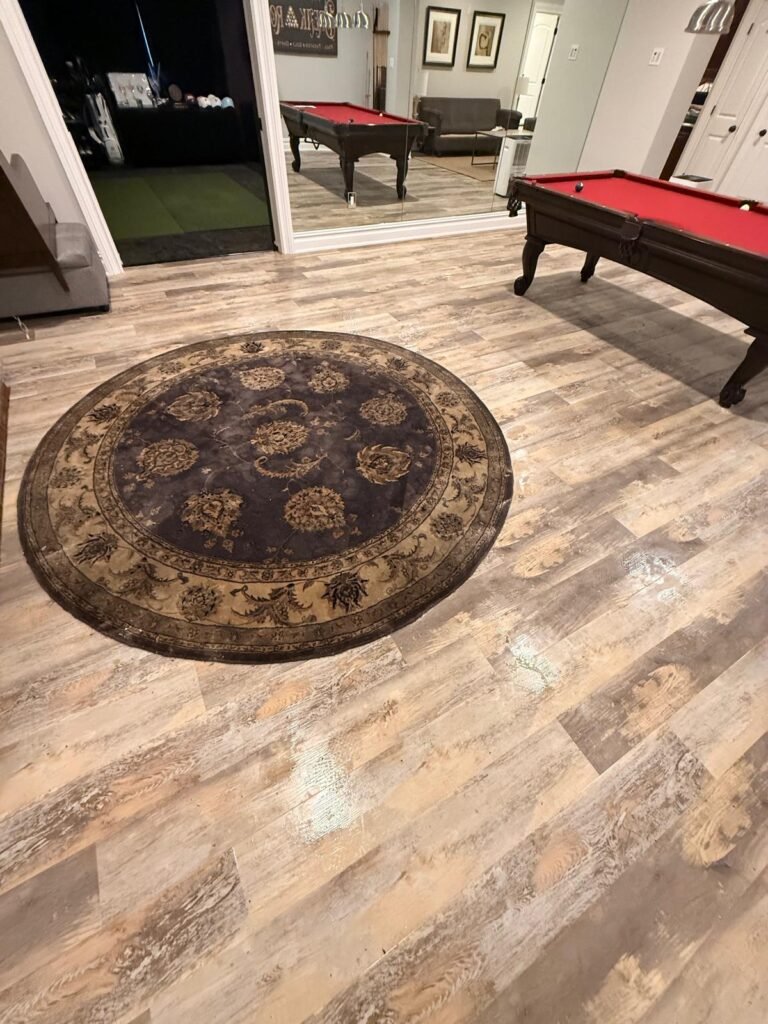
The Scope of a Flooded Basement in Saddle River, NJ
The basement in this Saddle River home was fully finished and heavily used. The lower level included a large family room with wall-to-wall carpet, a full wet bar with granite countertops and custom cabinetry, an entertainment area with a pool table sitting on luxury vinyl plank flooring, a private bedroom with carpet, and connecting hallways between all of these spaces.
When water floods a finished basement of this size and complexity, the damage does not stay in one place. Water follows the path of least resistance. On carpet, it spreads laterally through the padding before it ever reaches the carpet fibers you can see. On vinyl plank, it travels along the seams and pools underneath the planks where you cannot see it. Against walls, it wicks upward into the drywall and baseboards through capillary action. Every different material in the room absorbs and releases moisture at a different rate, and every transition between materials creates a potential hiding spot for trapped water.
For a homeowner looking at a flooded basement for the first time, it can be tempting to grab towels, shop vacs, and box fans and try to handle it. That approach almost always fails, not because homeowners are not trying hard enough, but because the equipment is not up to the actual scope of the problem. A shop vac pulls up the visible puddle but cannot extract water from under a vinyl plank or out of carpet padding. A box fan moves air across a surface but cannot reduce the humidity inside a wall cavity. Within 24 to 48 hours, any moisture left behind begins supporting mold growth, and what started as a water damage job turns into a mold remediation job on top of it.
Why Moisture Mapping Is the First Step, Not Drying
When our crew arrives at a job like this one, the first step is never to start setting up dehumidifiers. The first step is to figure out exactly where the water went.
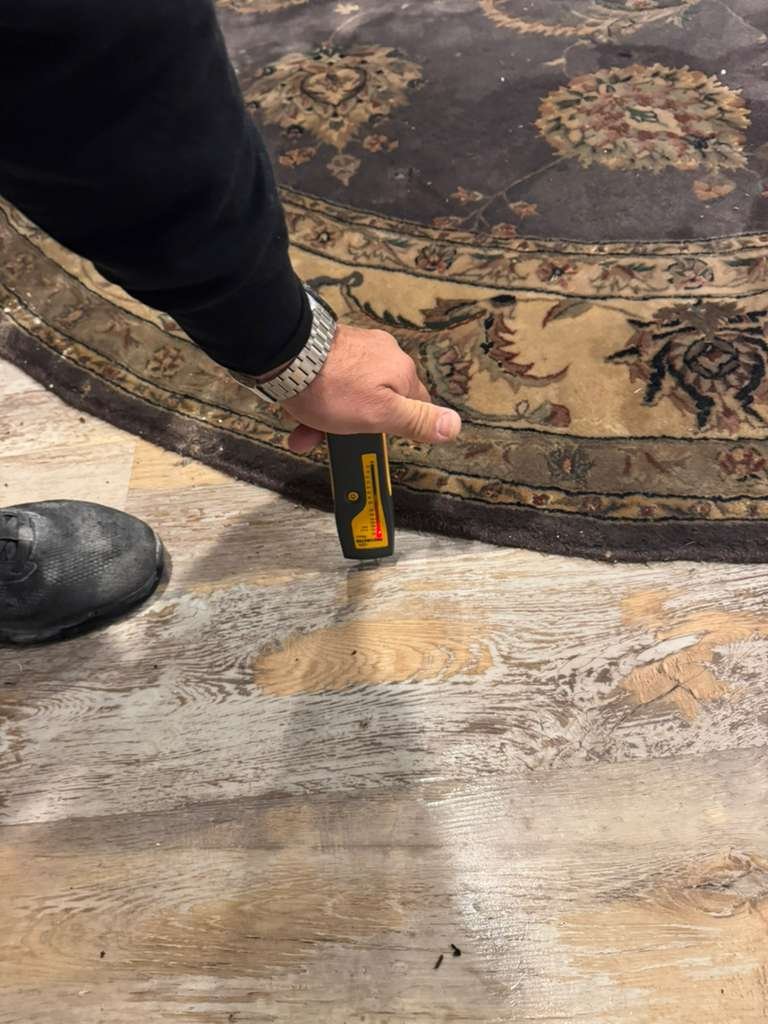
In the photo, one of our technicians is taking readings with a Protimeter moisture meter, one of the industry standard tools for measuring moisture content in building materials. The meter gives a reading on a color coded scale, green for dry, yellow for at-risk, and red for wet. By taking readings across the floor, along the baseboards, at different heights on the walls, and at every transition between rooms, our team can map the exact boundaries of the wet area.
This step matters for three reasons.
First, it drives the drying plan. Commercial dehumidifiers and air movers are expensive to run and must be placed where they actually pull moisture out. Guessing based on what looks wet is not good enough. Without instruments, it is almost certain that some wet area gets missed and some dry area gets over-dried. Moisture mapping produces a real plan based on real readings.
Second, it produces the documentation that drives the insurance claim. Every moisture reading becomes part of the Xactimate estimate we prepare for the carrier. When an insurance adjuster sees that Restorian has documented every affected area with meter readings, before and after photos, and daily monitoring logs, the claim moves faster and with less dispute. This is one of the reasons water damage restoration projects handled by certified restoration teams typically settle with insurance more smoothly than projects handled by general contractors.
Third, it establishes the baseline. Every day we remain on the job, we take new readings in the same locations and track the progress of the drying. The job is not complete when the surfaces look dry. It is complete when the meter confirms the materials have returned to normal moisture content. This is the part that DIY attempts can never replicate.
What Caused the Flood
We cannot share the specific source for this particular home, but basement flooding in Saddle River and across Bergen County tends to come from a handful of common causes. Understanding what typically goes wrong helps homeowners identify risks before they turn into a full emergency.
Sump pump failure. Most finished basements in Bergen County depend on a sump pump to handle groundwater seepage. When the pump fails, whether from a power outage, a stuck float switch, a burned out motor, or a discharge line freezing or clogging, water has nowhere to go and rises into the finished space. This is the single most common cause of basement flooding we respond to in the county.
Heavy rain and saturated soil. Saddle River, along with much of Bergen County, sits on soil that reaches saturation quickly during spring and summer storms. When the ground cannot absorb any more water, the excess pushes horizontally and finds its way through foundation cracks, window wells, and utility penetrations into the basement. Hurricane Ida in 2021 demonstrated this pattern at scale across northern New Jersey.
Plumbing failures. A burst supply line, a cracked drain pipe, a failed water heater, or an appliance connection leak can send significant water into a basement quickly. These events are especially damaging because they often happen while the homeowner is away or asleep, and the water runs for hours before anyone notices.
Sewer backup. Less common but more serious, sewer backups push contaminated water into basements through floor drains, toilets, and lower level fixtures. These require different handling than clean water events because the water is classified as Category 3, which means affected porous materials cannot be saved and must be removed and properly disposed of.
Regardless of cause, the restoration response follows the same core sequence: stop the source, extract the water, map the moisture, dry the structure, and document everything for insurance. The specifics of how we approach a flood damage cleanup project vary based on the water category and the materials affected, but the fundamentals do not change.
The Drying Process
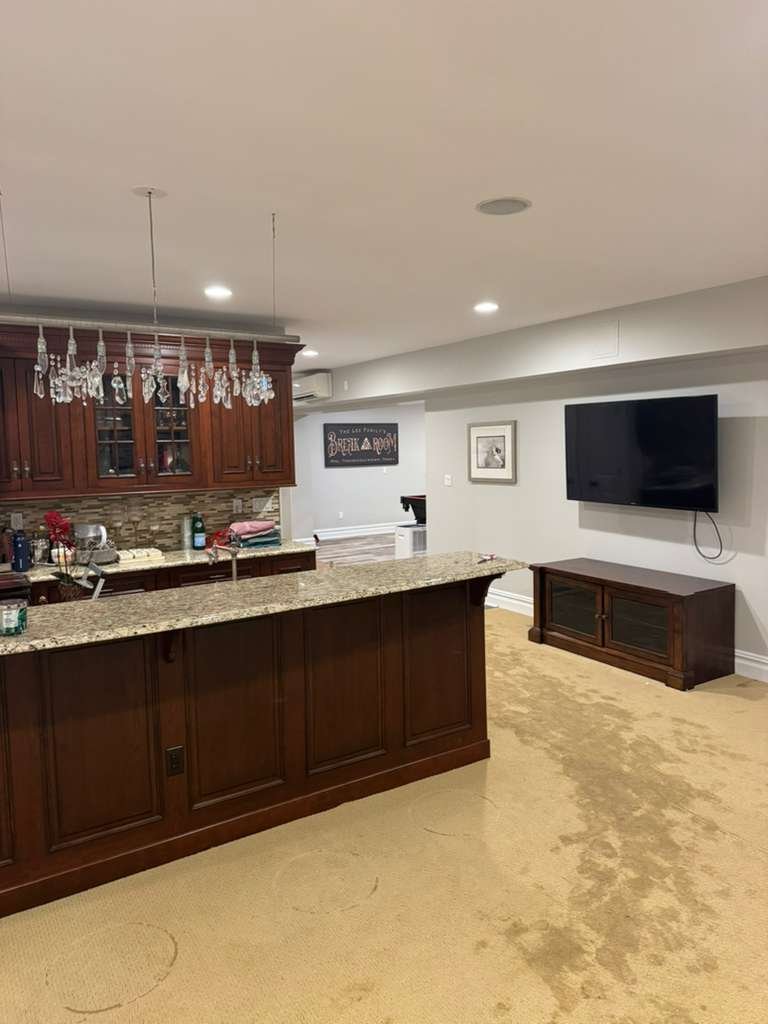
Once extraction is complete and moisture mapping is done, the drying phase begins. For a finished basement of this size, that typically means multiple commercial dehumidifiers and a larger number of air movers positioned strategically based on the meter readings.
A commercial dehumidifier is not a scaled up version of the one you might have in your basement for humidity control. It pulls moisture out of the air at several times the rate of a residential unit and operates continuously for days at a time. The air movers work with the dehumidifiers by keeping air moving across wet surfaces, which accelerates evaporation from the materials into the air where the dehumidifier can capture it.
On carpet, we typically lift the carpet away from the tack strips so air movers can blow underneath, drying the padding and subfloor simultaneously. On luxury vinyl plank, we may remove specific planks to access the subfloor below, or in some cases drill small weep holes at concealed locations so trapped water underneath can be extracted and dried. On walls where moisture has wicked into the drywall, we sometimes remove baseboards and drill small access points at the bottom of the wall cavity, allowing air to flow inside and dry the cavity without removing the full wall.
During the drying phase, our team returns daily to take new moisture readings, adjust equipment placement based on the progress, and log every reading for the insurance file. Typical drying times for a flooded basement range from three to seven days depending on the extent of the water, the materials affected, and the ambient conditions.
Once every reading confirms the materials have returned to normal moisture content, the equipment is removed, antimicrobial treatment is applied to surfaces that were wet, and the project moves into the repair and reconstruction phase if any materials were removed for drying access.
What Saddle River Homeowners Should Do If They Find a Flooded Basement
If you walk downstairs and find water in your finished basement, the first hour matters more than anything else. Here are the steps that make the biggest difference.
Stay out of the water if there is any chance it has reached electrical outlets, appliances, or the panel. If in doubt, shut off power to the basement at the breaker before you step into the water. Document the damage with photos and short video clips before you move anything. These images become part of your insurance claim and cannot be recreated later. If the source of the water is visible and controllable, such as a supply line valve or a burst appliance hose, shut it off. If it is groundwater or a sump pump failure, do not try to handle the source yourself, we can coordinate with your plumber once we arrive.
Call a restoration team before you call your insurance carrier. This sounds counterintuitive, but the restoration team can stop the damage from spreading and begin documentation while you are still on hold with the claims line. We handle the insurance coordination from there, including the Xactimate estimate, adjuster communication, and direct billing to the carrier.
Do not walk on wet carpet more than you have to. Every step pushes water deeper into the padding and subfloor.
Do not try to lift wet rugs or furniture on your own. They are significantly heavier when saturated and can cause injury.
Do not assume that because it looks dry a few hours later, it is dry. Surface evaporation is deceptive. The moisture underneath the vinyl plank, inside the wall cavity, or trapped in carpet padding is what causes the real damage.
Working With Insurance on Basement Flooding Claims
Insurance coverage for basement flooding in New Jersey depends on the source of the water. This is one of the most misunderstood areas of homeowner coverage.
Standard homeowner policies generally cover sudden and accidental water damage from inside the home, including burst pipes, appliance failures, water heater ruptures, and certain plumbing problems. They typically do not cover external flooding from groundwater, heavy rain entering through foundation cracks, or rising surface water from nearby bodies of water. That kind of event requires a separate flood insurance policy, usually through the National Flood Insurance Program or a private flood carrier.
Sump pump failures sit in a gray area. Some policies include limited sump pump failure coverage, others exclude it entirely, and some offer it as an add on rider. This is worth checking in your policy before you need it.
When we respond to a flooded basement in Saddle River, one of the first things our estimators do is determine the likely source of the water so we know which policy or policies apply. We then prepare Xactimate documentation that matches the carrier’s expectations, photograph every affected area, log every moisture reading, and submit everything directly to the adjuster. We work with all major carriers including NJM Insurance Group, State Farm, USAA, Allstate, AIG, Progressive, American Family Insurance, Nationwide, Liberty Mutual, Farmers Insurance, and NFIP participating carriers.
If you are considering additional coverage, a good time to review your policy is before the spring and summer storm season, not during it. Your agent can walk through flood insurance options and sump pump riders specific to your situation.
Flooded Basement Response Across Saddle River and Bergen County
Restorian provides 24/7 emergency response to flooded basements across Saddle River and all of Bergen County. Our crews are positioned at multiple points across northern New Jersey, which means response times to Saddle River, Upper Saddle River, Ho-Ho-Kus, Waldwick, Ridgewood, Midland Park, Allendale, and the surrounding Bergen County communities are typically within a short window of the initial call.
Every flooded basement project includes a dedicated project manager who serves as your single point of contact from the first call through the final walkthrough. The project manager coordinates the extraction crew, the drying crew, the insurance documentation, any subcontractors needed for source repair, and the reconstruction phase if materials need to be replaced. You do not have to track down separate crews, chase separate invoices, or explain the situation over and over to different people.
If you are dealing with a flooded basement in Saddle River right now, or if you suspect you might be, do not wait to see if it resolves on its own. The first 24 hours determine whether this becomes a manageable project or a much larger one.
📞 (888) 788-5038 🌐 restorian.co 📍 Serving Saddle River, Bergen County, and all of New Jersey
Follow Our Socials:
Google – Facebook – X (Twitter) – Instagram – Pinterest – Linkedin – Youtube
Renew. Rebuild. Restore.